<?xml version="1.0" encoding="utf-8"?>
<feed xmlns="http://www.w3.org/2005/Atom">
    <id>https://oicos.systems/de/blog</id>
    <title>OiC.OS Blog</title>
    <updated>2026-07-15T00:00:00.000Z</updated>
    <generator>https://github.com/jpmonette/feed</generator>
    <link rel="alternate" href="https://oicos.systems/de/blog"/>
    <subtitle>OiC.OS Blog</subtitle>
    <icon>https://oicos.systems/de/img/oicos_logo_icon.png</icon>
    <entry>
        <title type="html"><![CDATA[Kabbalah and Economics — reading Michael Snoyman against MoMaT]]></title>
        <id>https://oicos.systems/de/blog/kabbalah-economics-michael-snoyman</id>
        <link href="https://oicos.systems/de/blog/kabbalah-economics-michael-snoyman"/>
        <updated>2026-07-15T00:00:00.000Z</updated>
        <summary type="html"><![CDATA[Michael Snoyman published a striking post this week violence, free markets, socialism, and low time preference.]]></summary>
        <content type="html"><![CDATA[<p>Michael Snoyman published a striking post this week: <strong><a href="https://www.snoyman.com/blog/2026/07/kabbalah-economics/" target="_blank" rel="noopener noreferrer" class="">Kabbalah and Economics</a></strong> (15 July 2026), a sequel to his earlier comparison of Kabbalah with Haskell. This time he maps the Kabbalistic categories of <em>giving</em> and <em>receiving</em> — each split by <strong>action</strong> and <strong>intent</strong> — onto four economic settings: violence, free markets, socialism, and low time preference.</p>
<p>We read it against our axiomatic monetary theory (<strong>MoMaT</strong>). Where Snoyman argues normatively and theologically, we argue formally and institutionally — and the structural parallels run deeper than the difference in idiom suggests.</p>
<h2 class="anchor anchorTargetStickyNavbar_Vzrq" id="michaels-framework-in-brief">Michael's framework in brief<a href="https://oicos.systems/de/blog/kabbalah-economics-michael-snoyman#michaels-framework-in-brief" class="hash-link" aria-label="Direkter Link zur Michael's framework in brief" title="Direkter Link zur Michael's framework in brief" translate="no">​</a></h2>
<p>At the root sits <em>ratzon lekabel</em> — the <strong>desire to receive</strong>. Creation, on this reading, is built from want, and the spiritual task is to move toward giving. That is hard precisely because receiving is where everyone starts.</p>
<p>Michael grades this into four levels (action × intent):</p>
<table><thead><tr><th>Action</th><th>Intent</th><th>Economic reading</th></tr></thead><tbody><tr><td>Receiving</td><td>Receiving</td><td>Pure selfishness; violence as the extreme case</td></tr><tr><td>Giving</td><td>Receiving</td><td>Voluntary trade: give the apple, want the money</td></tr><tr><td>Giving</td><td>Giving</td><td>True altruism — rare in practice</td></tr><tr><td>Receiving</td><td>Giving</td><td>Highest level in Kabbalah; Michael sets it aside for the economics comparison</td></tr></tbody></table>
<p>From there he diagnoses three macro systems:</p>
<ol>
<li class=""><strong>Violence</strong> — receiving-to-receive. Theft, conquest, slavery. Destructive; few defend it openly today.</li>
<li class=""><strong>Free markets (idealised)</strong> — giving-to-receive. Voluntary exchange, full information, fair courts, <strong>hard money</strong>. Productive, but cannot by itself produce selflessness.</li>
<li class=""><strong>Socialism</strong> — aims at giving-to-give, but in practice reverts to receiving-to-receive under coercion: forced transfer is still taking.</li>
</ol>
<p>His conclusion: selflessness cannot be imposed at gunpoint. Let selfishness run the <strong>macro</strong> engine, and cultivate giving in the <strong>micro</strong> — family, close community. He closes by likening the Kabbalistic <em>masach</em> (the screen that defers immediate gratification) to <strong>low time preference</strong>, and warns that inflation pushes the other way.</p>
<h2 class="anchor anchorTargetStickyNavbar_Vzrq" id="capitalism-in-momat-the-arg-core">Capitalism in MoMaT: the A–R–G core<a href="https://oicos.systems/de/blog/kabbalah-economics-michael-snoyman#capitalism-in-momat-the-arg-core" class="hash-link" aria-label="Direkter Link zur Capitalism in MoMaT: the A–R–G core" title="Direkter Link zur Capitalism in MoMaT: the A–R–G core" translate="no">​</a></h2>
<p>MoMaT does not define capitalism by ideology or morality. Its <strong>core functionality</strong> is <strong>A–R–G</strong> — three coupled forms of sharing (German: <em>Arbeit</em>, <em>Risiko</em>, <em>Gewinn</em>):</p>
<table><thead><tr><th>Letter</th><th>German</th><th>English</th><th>What is shared</th></tr></thead><tbody><tr><td><strong>A</strong></td><td>Arbeit</td><td><strong>Labour</strong></td><td>Division of labour — who produces what, specialised roles, coordinated output</td></tr><tr><td><strong>R</strong></td><td>Risiko</td><td><strong>Risk</strong></td><td>Division of risk — who bears production, credit, and settlement uncertainty</td></tr><tr><td><strong>G</strong></td><td>Gewinn</td><td><strong>Profit</strong></td><td>Division of profit — how surplus, once validated by demand, is allocated</td></tr></tbody></table>
<p><strong>A (labour sharing):</strong> No household produces everything it consumes. Work is specialised, and coordination runs through contracts, wages, and the credit that <strong>pre-finances</strong> production before any sale returns.</p>
<p><strong>R (risk sharing):</strong> Risk never disappears — it is <strong>absorbed up a hierarchy</strong>. Workers and suppliers prefer stable income and pass production risk to entrepreneurs; entrepreneurs pass credit and liquidity risk to banks; banks pass systemic risk to the central bank. Interest is the <strong>insurance premium</strong> for that absorption, not a rent on idle metal.</p>
<p><strong>G (profit sharing):</strong> Profit appears only when invested production meets <strong>real demand</strong> and closes the cycle. In the market reading it is the return to those who pre-financed and bore the risk — a <strong>risk premium</strong>, not evidence of exploitation. But profit is more than a risk reward: it is a <strong>share of the common product</strong> created by the division of labour, and <em>how</em> that share is cut is a separate, explicit institutional choice.</p>
<p>And here MoMaT makes a claim we do not make lightly. <strong>For the first time, profit sharing has an explicit algebraic handle</strong> — not only as the reward for risk absorption inside a firm or up the banking hierarchy, but as a <strong>calculable share of the common product of shared labour</strong>. The accounting layer is built as the coproduct of three Lawvere theories, <code>T_DEB + T_Val + T_QEB</code>: double-entry debit/credit (<code>T_DEB</code>), mark-to-market <strong>valuation</strong> (<code>T_Val</code>, quantity × price), and the bilateral quadruple-entry bookings (<code>T_QEB</code>). Crucially, equity splits as <code>EK = FE + RE</code>: <strong>Financial Equity</strong>, a model of <code>T_DEB</code> that stays <strong>invariant under any change of valuation</strong> (the gauge invariance of the books), and <strong>Real Equity</strong>, a model of <code>T_Val</code> that depends on the chosen valuation functor.</p>
<p>Distribution lives <strong>entirely in the valuation theory</strong> and is orthogonal to the settlement invariants. That is what makes the old <strong>"dividing the cake" problem</strong> — the socialist and Marxian question of sharing the social product, GDP — a well-posed, computable object rather than a slogan. Different valuation regimes (historic cost, fair value, market prices, even plan prices) are different <em>models of the same theory</em> <code>T_Val</code>; each is a different <strong>cut of the same cake without enlarging or shrinking it</strong>. The GDP split itself is an aggregation–disaggregation adjunction (<code>Σ ⊣ Π</code>) with an explicit distribution vector whose shares sum to one. So the classical dream of sharing the common product <em>is</em> expressible in MoMaT: as an explicit, auditable valuation choice on books that balance under any gauge. MoMaT does not decree the split — it makes the split <strong>calculable, bookable, and open to institutional design</strong>. (Worked out in the distribution chapter of the <a href="https://oicos.systems/de/assets/files/menendez-winschel-2026-axiomatik-oekonomik-df5e3825b49b0cf896a0341ce6e96307.pdf" target="_blank" class="">monograph</a>.)</p>
<p>Capitalism, on this reading, is the machinery that makes A–R–G <strong>composable, bookable, and learnable</strong> — from a household ledger to central-bank settlement. Markets are one expression of it: voluntary exchange as <strong>giving to receive</strong>, routed through typed debt and accounting invariants.</p>
<h2 class="anchor anchorTargetStickyNavbar_Vzrq" id="the-capitalist-cycle-as-hylomorphism">The capitalist cycle as hylomorphism<a href="https://oicos.systems/de/blog/kabbalah-economics-michael-snoyman#the-capitalist-cycle-as-hylomorphism" class="hash-link" aria-label="Direkter Link zur The capitalist cycle as hylomorphism" title="Direkter Link zur The capitalist cycle as hylomorphism" translate="no">​</a></h2>
<p>What ties A–R–G together over time is a <strong>hylomorphism</strong> — the composition of an <strong>unfold</strong> and a <strong>fold</strong>. In the semantics of programming languages and category theory (familiar ground for Michael's Haskell readers):</p>
<table><thead><tr><th>Side</th><th>Categorical object</th><th>Operation</th><th>Standard name</th><th>Economic role</th></tr></thead><tbody><tr><td><strong>Coalgebra</strong></td><td><code>γ : S → F S</code></td><td><strong>unfold</strong></td><td><strong>anamorphism</strong> <code>⟨γ⟩ : S → νF</code></td><td><strong>Investment</strong> — open the future</td></tr><tr><td><strong>Algebra</strong></td><td><code>α : F A → A</code></td><td><strong>fold</strong></td><td><strong>catamorphism</strong> <code>(α) : μF → A</code></td><td><strong>Demand</strong> — close against reality</td></tr></tbody></table>
<p><strong>Unfold (coalgebra / anamorphism).</strong> A coalgebra <code>γ</code> sends a current state <code>S</code> to a one-step extension <code>F S</code> — a <em>possible next shape</em>. Iterating <code>γ</code> <strong>unfolds</strong> a tree of futures. In MoMaT this is <strong>credit-financed investment</strong>: from today's balance sheet, contracts and credit <strong>entail</strong> wages, inputs, production steps, and payment obligations branching forward in time. Production stays speculative until it is tested. Marx's <code>G → W → P</code> (money → commodities → production) lives on this side.</p>
<p><strong>Fold (algebra / catamorphism).</strong> An algebra <code>α</code> sends a composite <code>F A</code> back to a result <code>A</code> — it <strong>collapses</strong> structure into a value. In MoMaT this is <strong>demand and settlement</strong>: sales revenue, profit or loss, debt repayment, and cash settlement <strong>fold</strong> the production tree back onto the books. Marx's <code>W' → G'</code> (realised commodities → more money) closes the arc. <strong>Demand validates investment</strong> — ex post, never by decree.</p>
<p><strong>Hylomorphism</strong> <code>h = (α) ∘ ⟨γ⟩</code> is the full loop: unfold a promise into the future, then fold reality back onto it. Failed validation writes off (the fold returns a loss); successful validation closes the books and funds the next unfold. That is how the system <strong>learns</strong>, cycle by cycle. The wage is paid <em>before</em> the sale (unfold); the sale decides whether the unfold was justified (fold). Risk sharing (R) lives between the two phases; profit sharing (G) is the reward of a successful fold.</p>
<p>Michael's <em>masach</em> — deferring immediate receiving — has a structural echo here: the unfold <em>defers</em> gratification, the fold <em>defers judgment</em> until demand speaks. But MoMaT reads this as mechanics, not moral psychology. It is the <strong>typed chronomorphism</strong> of a credit economy: promises into the future, validated when settlement arrives.</p>
<h2 class="anchor anchorTargetStickyNavbar_Vzrq" id="momat-top-level-structure-acccat-deccat-govcat">MoMaT top-level structure: AccCat, DecCat, GovCat<a href="https://oicos.systems/de/blog/kabbalah-economics-michael-snoyman#momat-top-level-structure-acccat-deccat-govcat" class="hash-link" aria-label="Direkter Link zur MoMaT top-level structure: AccCat, DecCat, GovCat" title="Direkter Link zur MoMaT top-level structure: AccCat, DecCat, GovCat" translate="no">​</a></h2>
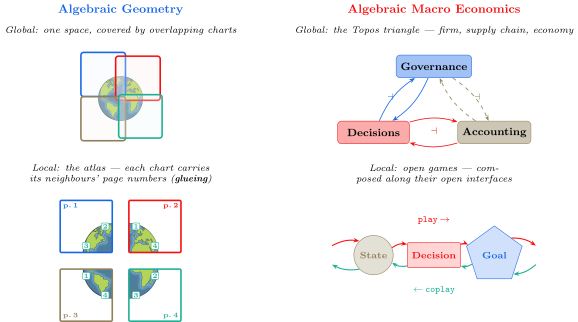
<p>Above A–R–G and the hylomorphism sits MoMaT's <strong>top-level architecture</strong> — three coupled categories that share one <strong>topos</strong> (a single institutional world, not three siloed tools). The triangle below is the canonical MoMaT picture; <a class="" href="https://oicos.systems/de/docs/products/magic-sauce">Magic Sauce</a> shows how it is glued together from local open games. <a class="" href="https://oicos.systems/de/docs/research/related-research">Related research</a> maps it onto Ostrom's three institutional layers, and the <a class="" href="https://oicos.systems/de/engine">engine preview</a> renders the same stack as an interactive 3D scene.</p>
<p><img decoding="async" loading="lazy" alt="MoMaT Topos triangle: GovCat, DecCat, and AccCat" src="https://oicos.systems/de/assets/images/baea2bf9d179e6f5-e9dc341fbc029743a4569d60c581c757.svg" width="578" height="322" class="img_ev3q"></p>
<p><em>The global Topos triangle — <strong>Governance</strong>, <strong>Decisions</strong>, <strong>Accounting</strong> (GovCat / DecCat / AccCat) — coupled by three adjunctions. Local open games compose along their interfaces to build this institutional geometry; see <a class="" href="https://oicos.systems/de/docs/products/magic-sauce">Magic Sauce</a> for the full picture.</em></p>
<table><thead><tr><th>Category</th><th>Plain name</th><th>What it holds</th><th>Economic question</th></tr></thead><tbody><tr><td><strong>AccCat</strong></td><td><strong>Accounting</strong></td><td>DEB/QEB, T-accounts, settlement, gauge invariance</td><td><em>Do the books balance?</em> — unconditional substrate</td></tr><tr><td><strong>DecCat</strong></td><td><strong>Decisions</strong></td><td>Open Games, strategies, forecasts, play and coplay</td><td><em>What do agents do?</em> — investment, pricing, demand</td></tr><tr><td><strong>GovCat</strong></td><td><strong>Governance</strong></td><td>Contracts, deontic rules, mandates, compliance</td><td><em>Which moves are admissible?</em> — the rulebook</td></tr></tbody></table>
<p><strong>AccCat</strong> is the <strong>substrate</strong>. Quadruple entry and cash as terminal settlement are not optional add-ons to price theory — they are the coordinate system every behavioural theory has to pass through. Nothing in DecCat or GovCat can override arithmetic.</p>
<p><strong>DecCat</strong> is the <strong>field of play</strong>. Firms, banks, and households act as compositional open games — locally egoistic lenses (Smith's bakers and butchers) that learn from forecast errors via <strong>Sim ⊣ Est</strong> against the realised accounts in AccCat.</p>
<p><strong>GovCat</strong> is the <strong>rule layer</strong>. Loan, wage, and settlement contracts type which games and postings are allowed to run at all. Institutions learn <em>over</em> their rules through <strong>Constrain ⊣ MechDesign</strong> with DecCat — mechanism design meeting constitutional constraint.</p>
<h3 class="anchor anchorTargetStickyNavbar_Vzrq" id="two-adjunctions--and-the-third-they-imply">Two adjunctions — and the third they imply<a href="https://oicos.systems/de/blog/kabbalah-economics-michael-snoyman#two-adjunctions--and-the-third-they-imply" class="hash-link" aria-label="Direkter Link zur Two adjunctions — and the third they imply" title="Direkter Link zur Two adjunctions — and the third they imply" translate="no">​</a></h3>
<p>The triangle carries <strong>two genuine learning loops</strong>, one fast and one slow. The <strong>third edge</strong> — GovCat ↔ AccCat — is not a third loop but their <strong>composition</strong>: the round trip that makes <strong>audit</strong> well defined.</p>
<table><thead><tr><th>Adjunction</th><th>Edge</th><th>Clock</th><th>What moves</th></tr></thead><tbody><tr><td><strong>Sim ⊣ Est</strong></td><td>DecCat ↔ AccCat</td><td><strong>Fast</strong> (operational)</td><td>Decisions become bookings; realised accounts drive the next decision — plan vs actual under <em>fixed</em> rules</td></tr><tr><td><strong>Constrain ⊣ MechDesign</strong></td><td>GovCat ↔ DecCat</td><td><strong>Slow</strong> (systemic)</td><td>Contracts define admissible play; persistent gaps revise the rules — covenants, mandates, mechanism design</td></tr><tr><td><strong>Pull ⊣ Push</strong></td><td>GovCat ↔ AccCat</td><td><strong>Composite</strong> (audit)</td><td><em>Implied</em> by the two above — one full round trip, both directions</td></tr></tbody></table>
<p><strong>Top-down</strong> (Push): Gov → Dec → Acc. A rule becomes a decision, a decision becomes a booking — each step <strong>adds</strong> detail (covenant → journal entry). <strong>Bottom-up</strong> (Pull): Acc → Dec → Gov. Books roll up into decisions and then into a governance verdict — each step <strong>summarises</strong> and <strong>drops</strong> detail. DecCat sits <strong>inside</strong>; GovCat and AccCat face the <strong>boundary</strong> — contracts on one side, cash and balances on the other.</p>
<p>The <strong>GovCat ↔ AccCat</strong> edge is that same chain read as a single arc:</p>
<ol>
<li class=""><strong>Down:</strong> contracts mandate what <strong>must</strong> be booked — what the rule layer requires to appear in the ledger.</li>
<li class=""><strong>Up:</strong> the books reveal whether compliance <strong>was</strong> achieved — and here the <strong>audit gap</strong> is <strong>measured</strong>.</li>
</ol>
<p>That gap — what contracts <em>require</em> booked versus what <em>is</em> booked — surfaces <strong>only</strong> on this Gov–Acc round trip. It is the core audit quantity, and it <strong>decomposes</strong> into two causes:</p>
<ul>
<li class=""><strong>Wrong execution</strong> (right rules, wrong decisions) → fix the <strong>operational</strong> loop (Dec ↔ Acc).</li>
<li class=""><strong>Wrong rules</strong> (rules that cannot be executed, or no longer fit reality) → fix the <strong>systemic</strong> loop (Gov ↔ Dec).</li>
</ul>
<p>One number, two causes. Audit is then not a separate department sampling vouchers after the fact; it is the <strong>composed adjunction</strong> pointing to <em>where</em> the institution must learn next. It also settles <strong>what data to gather</strong> between governance and accounting: not everything twice, but the <strong>mandated booking set</strong> (from Gov, pushed down) against the <strong>realised posting set</strong> (from Acc, pulled up), with DecCat as the channel where execution variance shows up.</p>
<p>Michael's macro/micro split has a direct homologue: <strong>selfish play in DecCat</strong>, <strong>rule-bound settlement in AccCat</strong>, <strong>admissibility in GovCat</strong>. His worry about coercion is a <strong>GovCat pathology</strong> — forced identification of agents, rules that cannot glue local action to global demand. His idealised market is a <strong>DecCat</strong> achievement under <strong>GovCat</strong> rules (voluntary contract, fair courts), with outcomes booked in <strong>AccCat</strong> — and the <strong>audit loop</strong> is where you see whether the three still compose.</p>
<p>Elinor Ostrom's constitutional / collective-choice / operational stack is the same trinity under another name — see the table in <a class="" href="https://oicos.systems/de/docs/research/related-research">Related research</a>. Compositionality across the three layers is exactly what lets polycentric governance work without a single planner.</p>
<h2 class="anchor anchorTargetStickyNavbar_Vzrq" id="where-momat-agrees">Where MoMaT agrees<a href="https://oicos.systems/de/blog/kabbalah-economics-michael-snoyman#where-momat-agrees" class="hash-link" aria-label="Direkter Link zur Where MoMaT agrees" title="Direkter Link zur Where MoMaT agrees" translate="no">​</a></h2>
<h3 class="anchor anchorTargetStickyNavbar_Vzrq" id="want-as-the-starting-point">Want as the starting point<a href="https://oicos.systems/de/blog/kabbalah-economics-michael-snoyman#want-as-the-starting-point" class="hash-link" aria-label="Direkter Link zur Want as the starting point" title="Direkter Link zur Want as the starting point" translate="no">​</a></h3>
<p>Michael's <em>ratzon lekabel</em> matches our core dynamic once you strip the theology: agents want, scarcity persists, and <strong>demand validates investment</strong>. The capitalist cycle is the <strong>hylomorphism</strong> above — credit and contracts <strong>unfold</strong> (coalgebra), sales and settlement <strong>fold</strong> (algebra). Failed validation writes off; successful validation closes the books and funds the next cycle. Want is not a moral defect but the driver the institutional geometry has to absorb.</p>
<h3 class="anchor anchorTargetStickyNavbar_Vzrq" id="free-markets-as-giving-to-receive">Free markets as "giving to receive"<a href="https://oicos.systems/de/blog/kabbalah-economics-michael-snoyman#free-markets-as-giving-to-receive" class="hash-link" aria-label="Direkter Link zur Free markets as &quot;giving to receive&quot;" title="Direkter Link zur Free markets as &quot;giving to receive&quot;" translate="no">​</a></h3>
<p>Michael's idealised market — no coercion, voluntary trade, honest information — maps cleanly onto the <strong>A–R–G core</strong>: labour is specialised (A), risk is borne by those who pre-finance (R), and profit rewards validated production (G). His apple seller and our baker are the same figure: the <em>act</em> is giving, the <em>intent</em> stays self-interested, and the system channels that interest productively through the A–R–G machinery.</p>
<p>We say the same in categorical language: Smith's invisible hand as local <strong>egoistic lenses</strong> in <strong>DecCat</strong>, and capitalism as a <strong>decentralised macro-learning system</strong> — agents update from forecast errors while institutions adapt on two levels, within rules and over rules in <strong>GovCat</strong>.</p>
<h3 class="anchor anchorTargetStickyNavbar_Vzrq" id="selfishness-is-channelled-not-abolished">Selfishness is channelled, not abolished<a href="https://oicos.systems/de/blog/kabbalah-economics-michael-snoyman#selfishness-is-channelled-not-abolished" class="hash-link" aria-label="Direkter Link zur Selfishness is channelled, not abolished" title="Direkter Link zur Selfishness is channelled, not abolished" translate="no">​</a></h3>
<p>Michael is explicit: charity and volunteering in market societies are rarely "pure" in the Kabbalistic sense — status, tax relief, and feeling good all count. Markets do not try to eliminate selfishness; they <strong>redirect</strong> it.</p>
<p>MoMaT does not moralise this away either. The <strong><a href="https://oicos.systems/de/blog/kabbalah-economics-michael-snoyman#momat-top-level-structure-acccat-deccat-govcat" class="">three-category stack</a></strong> replaces intent-typing altogether: AccCat asks whether the books balance, DecCat models what agents do strategically, GovCat holds the rules. The question is never purity of intent but whether <strong>demand validates investment</strong> and who bears which risk in the hierarchy (firm → bank → central bank).</p>
<h3 class="anchor anchorTargetStickyNavbar_Vzrq" id="socialism-right-goal-wrong-mechanism">Socialism: right goal, wrong mechanism<a href="https://oicos.systems/de/blog/kabbalah-economics-michael-snoyman#socialism-right-goal-wrong-mechanism" class="hash-link" aria-label="Direkter Link zur Socialism: right goal, wrong mechanism" title="Direkter Link zur Socialism: right goal, wrong mechanism" translate="no">​</a></h3>
<p>This is the strongest overlap.</p>
<p>Michael argues that socialism aims at giving-to-give but delivers receiving-to-receive: people "give" at gunpoint. Scarcity remains, "need" stays undefinable, production incentives weaken, and status competition simply moves to non-monetary channels.</p>
<p>We reach the same conclusion structurally rather than mystically. Central planning fails as a <strong>knowledge and coherence problem</strong> — Hayek's point, which in our framework is a <strong>sheaf pathology</strong>: local information does not glue into a global plan. When a central organ cannot see real demand, even well-intentioned intervention misallocates — the historical "ton ideology," where the plan counts tons instead of useful nails. <strong>Central-bank liquidity is necessary but never sufficient</strong>; production must still find real demand. Forced identification of agents in the macro game is the categorical counterpart to Michael's coercion diagnosis.</p>
<h3 class="anchor anchorTargetStickyNavbar_Vzrq" id="capitalism-is-not-intrinsically-evil">Capitalism is not intrinsically evil<a href="https://oicos.systems/de/blog/kabbalah-economics-michael-snoyman#capitalism-is-not-intrinsically-evil" class="hash-link" aria-label="Direkter Link zur Capitalism is not intrinsically evil" title="Direkter Link zur Capitalism is not intrinsically evil" translate="no">​</a></h3>
<p>Michael does not demonise markets. They are productive but, in his framing, do not fulfil "the purpose of Creation."</p>
<p>We push further toward <strong>demoralisation</strong>: capitalism is the A–R–G system — labour, risk, and profit sharing made explicit in the books. <strong>Exploitative systems are built by people, not by the mathematics of accounting.</strong> Distribution (G) and stability (R, settlement) are <strong>orthogonal</strong> in MoMaT: once quadruple entry and gauge invariance are in place, the split of the common product becomes an explicit, computable valuation choice — the <a href="https://oicos.systems/de/blog/kabbalah-economics-michael-snoyman#capitalism-in-momat-the-arg-core" class="">dividing-the-cake question</a> made well-posed — rather than something smuggled inside a single word, "money."</p>
<h2 class="anchor anchorTargetStickyNavbar_Vzrq" id="where-momat-diverges">Where MoMaT diverges<a href="https://oicos.systems/de/blog/kabbalah-economics-michael-snoyman#where-momat-diverges" class="hash-link" aria-label="Direkter Link zur Where MoMaT diverges" title="Direkter Link zur Where MoMaT diverges" translate="no">​</a></h2>
<h3 class="anchor anchorTargetStickyNavbar_Vzrq" id="hard-money">Hard money<a href="https://oicos.systems/de/blog/kabbalah-economics-michael-snoyman#hard-money" class="hash-link" aria-label="Direkter Link zur Hard money" title="Direkter Link zur Hard money" translate="no">​</a></h3>
<p>Michael's ideal market assumes <strong>hard money</strong> — money that privileged parties cannot create cheaply. He ties the <em>masach</em> to <strong>low time preference</strong> and faults inflation for pushing toward immediate consumption.</p>
<p>We argue the opposite on <strong>structural</strong> grounds. Gold- and scarcity-backed regimes live in a finite <strong>initial algebra</strong>: reserves deplete and stabilisation turns brittle (<code>gold-depletes</code> in our stability proofs). <strong>Fiat</strong> systems, by contrast, are a final <strong>coalgebra</strong> of the central bank: liquidity can be emitted to meet settlement need — the institutional reading of "whatever it takes." We share Michael's worry about <strong>privileged cheap money creation</strong>; our answer is <strong>institutionalised central-bank elasticity under accounting invariants</strong>, not a retreat to commodity scarcity as the stability anchor.</p>
<h3 class="anchor anchorTargetStickyNavbar_Vzrq" id="interest-is-not-time-preference">Interest is not time preference<a href="https://oicos.systems/de/blog/kabbalah-economics-michael-snoyman#interest-is-not-time-preference" class="hash-link" aria-label="Direkter Link zur Interest is not time preference" title="Direkter Link zur Interest is not time preference" translate="no">​</a></h3>
<p>Michael treats saving as low time preference — deferring consumption, "giving to your future self."</p>
<p>In MoMaT, <strong>interest is not time preference</strong>. Interest payments are <strong>insurance premia for risk absorption</strong> along the hierarchy: firms pay banks for portfolio and liquidity risk, banks pay the central bank for lender-of-last-resort insurance. Deferral (<em>Verzicht</em>) does appear — but in the <strong>hylomorphism</strong> (invest now, validate later), not as a psychological screen laid over desire.</p>
<h3 class="anchor anchorTargetStickyNavbar_Vzrq" id="inflation">Inflation<a href="https://oicos.systems/de/blog/kabbalah-economics-michael-snoyman#inflation" class="hash-link" aria-label="Direkter Link zur Inflation" title="Direkter Link zur Inflation" translate="no">​</a></h3>
<p>Michael treats inflation as something that discourages holding cash and encourages near-term consumption.</p>
<p>We treat it primarily as a <strong>valuation phenomenon</strong> — input prices, wages, resources — read through the <strong>valuation algebra</strong>, not as a purely monetary phenomenon in the Friedman sense. Central banks do not "control inflation" by rationing reserves alone; taking every price movement for a liquidity problem is itself a category error.</p>
<h3 class="anchor anchorTargetStickyNavbar_Vzrq" id="moral-intent-vs-typing">Moral intent vs typing<a href="https://oicos.systems/de/blog/kabbalah-economics-michael-snoyman#moral-intent-vs-typing" class="hash-link" aria-label="Direkter Link zur Moral intent vs typing" title="Direkter Link zur Moral intent vs typing" translate="no">​</a></h3>
<p>Michael's four levels are <strong>ethical</strong>: action and intent, pure and mixed motivation.</p>
<p>MoMaT replaces that grid with <strong>typing</strong>: giral money, reserves, and cash (G → R → C); claims versus terminal settlement; quadruple entry across paired double-entry systems. Charity may be impure in Michael's sense — for us the only diagnostic is whether the <strong>catamorphism of demand</strong> validates the <strong>anamorphism of investment</strong>, and whether the institution learns from the result.</p>
<h3 class="anchor anchorTargetStickyNavbar_Vzrq" id="teleology">Teleology<a href="https://oicos.systems/de/blog/kabbalah-economics-michael-snoyman#teleology" class="hash-link" aria-label="Direkter Link zur Teleology" title="Direkter Link zur Teleology" translate="no">​</a></h3>
<p>Michael's telos is selflessness and affinity with the divine. Ours is <strong>Oikos</strong>: continuity, learning, institutional coherence — Aristotle's household law made reflexive through accounting. The guiding motif of our program is a place where <strong>want and reality speak the same language</strong>, reached when dreams have become <strong>bookable</strong> — validation through demand and balance sheets, not refinement of the soul.</p>
<h2 class="anchor anchorTargetStickyNavbar_Vzrq" id="charity-is-a-public-good--the-missing-ostrom-step">Charity is a public good — the missing Ostrom step<a href="https://oicos.systems/de/blog/kabbalah-economics-michael-snoyman#charity-is-a-public-good--the-missing-ostrom-step" class="hash-link" aria-label="Direkter Link zur Charity is a public good — the missing Ostrom step" title="Direkter Link zur Charity is a public good — the missing Ostrom step" translate="no">​</a></h2>
<p>This is where we think Michael's argument takes a wrong turn — and where MoMaT quietly supplies what he is reaching for.</p>
<p>Michael wants <strong>giving-to-give</strong>: charity, selflessness, care beyond self-interest. In the language of economics that is not a private good traded in a market — it is a <strong>public good</strong>, non-rival, hard to exclude, and chronically under-provided by self-interested exchange. His own framing half-concedes it: markets are the macro engine for <em>selfishness</em>, while giving has to be cultivated separately in the micro.</p>
<p>Yet he still asks the <strong>free market</strong> to carry giving — "giving to receive." That is precisely the step an economist would not take. Markets allocate <strong>private</strong> goods well and provide <strong>public</strong> ones poorly; the free-rider problem is not a moral failing but the incentive geometry. Pure market dynamics under-provide charity for the same reason they under-provide clean air or flood defence.</p>
<p>The economist's answer to public goods is neither "let the market do it" nor "let the state command it." It is <strong>Elinor Ostrom's</strong> answer: <strong>polycentric governance</strong> — many overlapping centres of authority, local rules that compose, with neither a single market price nor a single planner in charge. Ostrom showed empirically that commons and shared provision are sustained this way, in the space <em>between</em> market and state.</p>
<p>And Ostrom's institutional stack is <strong>already MoMaT's stack</strong>:</p>
<table><thead><tr><th>Ostrom rule level</th><th>MoMaT category</th><th>Role</th></tr></thead><tbody><tr><td>Constitutional</td><td><strong>GovCat</strong></td><td>who may set rules — mandates, charters, deontic norms</td></tr><tr><td>Collective-choice</td><td><strong>DecCat</strong></td><td>strategic choice of policy and mechanism within those rules</td></tr><tr><td>Operational</td><td><strong>AccCat</strong></td><td>day-to-day action and the bookings it leaves behind</td></tr></tbody></table>
<p>This is not an analogy imposed after the fact; it is the same three-layer geometry — governance, strategic decision, operational accounting — that A–R–G and the audit loop already run on. See the mapping in <a class="" href="https://oicos.systems/de/docs/research/related-research">Related research</a>.</p>
<p>So the argument closes on itself. <strong>Polycentrism is what actually delivers Michael's charity</strong> — public-good provision between market and state. But polycentrism only works if the three layers <strong>compose</strong>: overlapping jurisdictions are coherent only when GovCat, DecCat, and AccCat glue level by level (household → association → municipality → state), and only when <em>the same</em> stack carries <strong>both</strong> private market production <strong>and</strong> public-good production on one set of books. That compositionality is exactly what MoMaT provides — the sheaf-gluing of local open games into a global institution, shown in <a class="" href="https://oicos.systems/de/docs/products/magic-sauce">Magic Sauce</a>.</p>
<p>Read this way, MoMaT does what Michael wants — but by the route he rules out. Giving-to-give is not something free markets secrete as a by-product; it is a public good that has to be <strong>institutionally engineered</strong>, and the engineering is polycentric composition of exactly the governance / decision / accounting layers MoMaT makes formal. His telos survives; only the mechanism changes — from "the market will provide" to "compose the institutions that provide."</p>
<h2 class="anchor anchorTargetStickyNavbar_Vzrq" id="one-sentence-each">One sentence each<a href="https://oicos.systems/de/blog/kabbalah-economics-michael-snoyman#one-sentence-each" class="hash-link" aria-label="Direkter Link zur One sentence each" title="Direkter Link zur One sentence each" translate="no">​</a></h2>
<p><strong>Michael:</strong> Markets are the right macro engine for selfishness; selflessness is micro-work; state coercion perverts the goal.</p>
<p><strong>MoMaT:</strong> Agreed on the engine — but it runs on typed debt-accounting with a fiat liquidity coalgebra, not hard money, and giving-to-give is a <strong>public good</strong>, delivered by Ostrom-style polycentric composition of governance, decision, and accounting rather than secreted by markets; the decisive question stays whether demand validates investment and whether institutions learn.</p>
<h2 class="anchor anchorTargetStickyNavbar_Vzrq" id="understand-it-first-then-use-it-for-good">Understand it first, then use it for good<a href="https://oicos.systems/de/blog/kabbalah-economics-michael-snoyman#understand-it-first-then-use-it-for-good" class="hash-link" aria-label="Direkter Link zur Understand it first, then use it for good" title="Direkter Link zur Understand it first, then use it for good" translate="no">​</a></h2>
<p>There is a bigger point underneath all of this. Capitalism is one of the great achievements of humanity — a sophisticated machine for sharing labour, risk, and profit at planetary scale, learning cycle by cycle from whether demand validates investment. Treating it as intrinsically evil is as unserious as treating it as automatically just. Both moves skip the only step that matters: <strong>understanding what the machine actually is.</strong></p>
<p>Most of the disappointment with markets comes from asking them to deliver what markets structurally <em>cannot</em> — public goods, charity, kindness, the giving-to-give that Michael rightly prizes. Markets are magnificent at allocating private goods and hopeless at provisioning public ones; blaming them for the second is like blaming a ledger for not being a prayer. Stop bashing capitalism for failing at a job it was never the right tool for, and a different possibility opens up: keep the engine for what it does superbly, and <strong>compose it</strong> — polycentrically, à la Ostrom — with institutions that provide what markets cannot.</p>
<p>That is the whole point of MoMaT. First <strong>understand</strong> capitalism precisely — not as sin and not as salvation, but as a typed, bookable, learnable architecture of labour, risk, and profit sharing, with distribution a computable choice rather than a hidden fate. Then, on that understanding, <strong>design</strong> it for the purposes we actually want it to serve. Once the books balance under any valuation gauge, once the three layers compose, once distribution is an explicit dial rather than a buried assumption, kindness and charity stop being sentiments we hope survive the market and become <strong>institutions we can engineer</strong> on the same foundations. Understand the achievement first; then use it for good. MoMaT is built to do exactly that.</p>
<h2 class="anchor anchorTargetStickyNavbar_Vzrq" id="further-reading">Further reading<a href="https://oicos.systems/de/blog/kabbalah-economics-michael-snoyman#further-reading" class="hash-link" aria-label="Direkter Link zur Further reading" title="Direkter Link zur Further reading" translate="no">​</a></h2>
<ul>
<li class="">Michael Snoyman — <strong><a href="https://www.snoyman.com/blog/2026/07/kabbalah-economics/" target="_blank" rel="noopener noreferrer" class="">Kabbalah and Economics</a></strong></li>
<li class="">OiC.OS — <strong><a class="" href="https://oicos.systems/de/docs/products/magic-sauce">Magic Sauce</a></strong> — Topos triangle and local open games (the TikZ figure above)</li>
<li class="">OiC.OS — <strong><a class="" href="https://oicos.systems/de/engine">Engine preview</a></strong> — interactive 3D view of the same three layers</li>
<li class="">OiC.OS — <strong><a class="" href="https://oicos.systems/de/docs/research/money-theory">Money Theory</a></strong> — shortest summary of the axiomatic framework</li>
<li class="">OiC.OS — <strong><a class="" href="https://oicos.systems/de/docs/vision/technology">Technology</a></strong> — three layers for CFOs and treasurers</li>
<li class="">OiC.OS — <strong><a class="" href="https://oicos.systems/de/docs/research/related-research">Related research</a></strong> — Ostrom ↔ GovCat / DecCat / AccCat</li>
<li class="">OiC.OS — <strong><a class="" href="https://oicos.systems/de/research/momat">MoMaT</a></strong> — the research program and open questions</li>
<li class="">OiC.OS — <strong><a href="https://oicos.systems/de/assets/files/menendez-winschel-2026-axiomatik-oekonomik-df5e3825b49b0cf896a0341ce6e96307.pdf" target="_blank" class="">Axiomatik der Ökonomik (PDF)</a></strong> — working draft of the German monograph</li>
</ul>
<p>Comments and collaboration: <a href="mailto:contact@oicos.systems" target="_blank" rel="noopener noreferrer" class="">contact@oicos.systems</a>.</p>]]></content>
        <author>
            <name>Viktor Winschel</name>
            <uri>https://oicos.systems</uri>
        </author>
        <category label="research" term="research"/>
        <category label="momat" term="momat"/>
        <category label="capitalism" term="capitalism"/>
        <category label="institutions" term="institutions"/>
    </entry>
    <entry>
        <title type="html"><![CDATA[Axiomatik der Ökonomik — MoMaT-A working draft online]]></title>
        <id>https://oicos.systems/de/blog/momat-a-milestone-axiomatik-oekonomik</id>
        <link href="https://oicos.systems/de/blog/momat-a-milestone-axiomatik-oekonomik"/>
        <updated>2026-07-04T00:00:00.000Z</updated>
        <summary type="html"><![CDATA[What is money? Martin Hellwig diagnosed in 1993, and again in 2018, that monetary theory has no conceptual foundations the same word for different types.]]></summary>
        <content type="html"><![CDATA[<p><strong>What is money?</strong> Martin Hellwig diagnosed in 1993, and again in 2018, that monetary theory has no conceptual foundations: the word "money" stands for at least four different things — legal tender, medium of exchange, macroeconomic aggregate, unit of account — without the difference ever being formalised. We read that as a <strong>type error</strong>: the same word for different types.</p>
<p>Our answer is now online as a <strong>working draft</strong> (<a href="https://oicos.systems/de/assets/files/menendez-winschel-2026-axiomatik-oekonomik-df5e3825b49b0cf896a0341ce6e96307.pdf" target="_blank" class="">PDF</a>): <em><strong>Axiomatik der Ökonomik</strong></em> — <em>Von Schuld- und Erfüllungsverträgen mit Geld, Zinsen und Lernen zum Topos der Wirtschaftspolitik</em>. Citation: <a class="" href="https://oicos.systems/de/docs/research/references#momat-a">MoMaT-A</a>.</p>
<p>This is the German monograph of the <strong>MoMaT program — Monetary Macro Accounting Theory</strong>. It builds on forty years of Renée Menéndez's work on credit-money capitalism, work by Viktor Winschel since 1996 on monetary theory, compositional game theory, and categorical semantics, and about a decade of joint development since 2018.</p>
<h2 class="anchor anchorTargetStickyNavbar_Vzrq" id="the-idea-in-one-sentence">The idea in one sentence<a href="https://oicos.systems/de/blog/momat-a-milestone-axiomatik-oekonomik#the-idea-in-one-sentence" class="hash-link" aria-label="Direkter Link zur The idea in one sentence" title="Direkter Link zur The idea in one sentence" translate="no">​</a></h2>
<p>Accounting is not an appendix to price theory. Double and quadruple entry, gauge invariance, and the three languages <strong>AccCat</strong> (accounting), <strong>DecCat</strong> (decisions), and <strong>GovCat</strong> (governance) are the geometry in which economic behaviour must live — from a household ledger to central-bank settlement.</p>
<h2 class="anchor anchorTargetStickyNavbar_Vzrq" id="ten-structural-results">Ten structural results<a href="https://oicos.systems/de/blog/momat-a-milestone-axiomatik-oekonomik#ten-structural-results" class="hash-link" aria-label="Direkter Link zur Ten structural results" title="Direkter Link zur Ten structural results" translate="no">​</a></h2>
<p><strong>1. A universal economic space.</strong> The axiomatics defines a minimal space — analogous to a Riemannian manifold — through which every behavioural theory must factor. Consistency of the books is not one constraint among others; it <em>is</em> the coordinate system of economics.</p>
<p><strong>2. Noether's theorem of accounting.</strong> From symmetry follows invariance. At the micro level every entry balances: debtor and creditor T-accounts must match across <strong>quadruple entry (QEB)</strong> over paired <strong>double-entry (DEB)</strong> systems. Aggregated to the macro level, the same law says that <strong>the world as a whole is not indebted</strong>: the sum of all claims equals the sum of all obligations, because every claim is someone else's liability. There are no net financial positions in a closed economy.</p>
<p><strong>3. Gauge invariance.</strong> A gauge structure formalises coordinate and unit independence — the freedom to re-express accounts in another currency or valuation without changing their economic content. This is where Hellwig's type error becomes visible: "euro" and "unit" are not strings but objects of different types.</p>
<p><strong>4. Profit and earnings sharing.</strong> With gauge invariance and quadruple entry in place, a division of profit and of results appears as coherent institutional design — not as an afterthought bolted onto marginal productivity.</p>
<p><strong>5. Distribution becomes discussable — on a firm footing.</strong> Only <em>after</em> QEB, gauge invariance, and the accounting Noether theorem are established can distribution questions be posed rigorously: wages, profit, risk premia, product shares. The framework separates what the books require from any particular distributional ideology.</p>
<p><strong>6. Three types of money and the absorption hierarchy.</strong> Money is not homogeneous. Typed as <strong>giral (book) money, reserves, and cash</strong> (G → R → C), it reveals the <strong>risk-absorption ladder</strong> of the economy: firms absorb risk first through retained earnings, then commercial banks, then the central bank as lender of last resort.</p>
<p><strong>7. Endogenous interest.</strong> The interest rate is <strong>endogenous</strong> — a <strong>risk-insurance premium</strong>, not a policy dial and not a rent on idle gold. Interest bans and "money breeding money" without production become empty categories in this geometry.</p>
<p><strong>8. Fiat money is inherently stable.</strong> Money backed by institutional invariants is not merely "more stable than gold" — it is stable <strong>by construction</strong>, through quadruple-entry closure. Commodity money carries no such guarantee. Stability is an institutional invariant, not a scarcity of metal.</p>
<p><strong>9. Cash as terminal settlement.</strong> In the axiomatics there is no untyped "money". <strong>Cash (C)</strong> is the <strong>terminal object</strong> — the settlement standard that discharges debt relations. Clearing and settlement are primary; exchange is secondary. A barter market with a Walrasian auctioneer has nothing to settle.</p>
<p><strong>10. Financial and real endowment together drive the dynamics.</strong> Neoclassical equilibrium theory lets the real endowment alone determine outcomes. Here the cycle is generated by <strong>financial and real endowment together</strong>: there is <strong>no production without prior financial endowment</strong> — credit, contracts, booking. The dynamics is a <strong>hylomorphism</strong>. Investment <strong>unfolds</strong> (a coalgebra: it opens a tree of production, credit, and contracts into the future); demand and settlement <strong>fold</strong> it back (an algebra: revenue, profit, or loss). <strong>Demand validates investment</strong>, ex post. Failed validation writes off and constrains the next cycle; successful validation closes the books and funds the next unfold. That loop is how the system <strong>learns</strong> — cycle by cycle — and why market economies, for all their faults, remain the most adaptive institutional setup humanity has built: they let promises be made into the future, test them against reality, book the result, and begin again.</p>
<h2 class="anchor anchorTargetStickyNavbar_Vzrq" id="where-to-read-next">Where to read next<a href="https://oicos.systems/de/blog/momat-a-milestone-axiomatik-oekonomik#where-to-read-next" class="hash-link" aria-label="Direkter Link zur Where to read next" title="Direkter Link zur Where to read next" translate="no">​</a></h2>
<ul>
<li class=""><strong><a class="" href="https://oicos.systems/de/docs/research/references#momat-a">MoMaT-A — References</a></strong> — citation key and PDF</li>
<li class=""><strong><a class="" href="https://oicos.systems/de/docs/research/money-theory">Money Theory</a></strong> — shortest summary of the framework</li>
<li class=""><strong><a class="" href="https://oicos.systems/de/research/momat">MoMaT</a></strong> — title pages and the fourteen open questions the program answers</li>
<li class=""><strong><a href="https://www.linkedin.com/posts/viktor-winschel_axiomatik-der-%C3%B6konomik-momat-a-working-activity-7479341029356298241-i1mU" target="_blank" rel="noopener noreferrer" class="">Announcement on LinkedIn</a></strong> — the ten results in short form (German)</li>
</ul>
<p>Comments and collaboration: <a href="mailto:contact@oicos.systems" target="_blank" rel="noopener noreferrer" class="">contact@oicos.systems</a>.</p>]]></content>
        <author>
            <name>Renée Menéndez</name>
            <uri>https://oicos.systems</uri>
        </author>
        <author>
            <name>Viktor Winschel</name>
            <uri>https://oicos.systems</uri>
        </author>
        <category label="research" term="research"/>
        <category label="momat" term="momat"/>
        <category label="axiomatics" term="axiomatics"/>
    </entry>
    <entry>
        <title type="html"><![CDATA[Proposal of a New Monetary Architecture]]></title>
        <id>https://oicos.systems/de/blog/monetary-architecture-interest-rate-regimes</id>
        <link href="https://oicos.systems/de/blog/monetary-architecture-interest-rate-regimes"/>
        <updated>2026-06-27T00:00:00.000Z</updated>
        <summary type="html"><![CDATA[We have added a new page on Monetary Architecture. It connects our Money Theory to the historical experience of interest-rate regimes — from compound interest and debt relief in antiquity to modern central-bank policy and the misalignment between fixed lending rates and real project risk.]]></summary>
        <content type="html"><![CDATA[<p>We have added a new page on <strong><a class="" href="https://oicos.systems/de/docs/vision/money-architecture">Monetary Architecture</a></strong>. It connects our <strong><a class="" href="https://oicos.systems/de/docs/research/money-theory">Money Theory</a></strong> to the historical experience of <strong>interest-rate regimes</strong> — from compound interest and debt relief in antiquity to modern central-bank policy and the misalignment between fixed lending rates and real project risk.</p>
<p>The page is available in two formats:</p>
<ul>
<li class=""><strong><a class="" href="https://oicos.systems/de/docs/vision/money-architecture">Podcast</a></strong> — listen to the full speech on the page (English audio)</li>
<li class=""><strong><a href="https://oicos.systems/de/assets/files/oic-os-monetary-architecture_en-c52fe4c1db1758021aad1ccbeda61cd1.pdf" target="_blank" class="">Slide deck (PDF)</a></strong> — the presentation as a downloadable deck</li>
</ul>
<h2 class="anchor anchorTargetStickyNavbar_Vzrq" id="why-this-matters">Why this matters<a href="https://oicos.systems/de/blog/monetary-architecture-interest-rate-regimes#why-this-matters" class="hash-link" aria-label="Direkter Link zur Why this matters" title="Direkter Link zur Why this matters" translate="no">​</a></h2>
<p>Classical interest compensates the lender in a rigid way, largely independent of whether the financed project succeeds or fails. That mismatch shows up again and again in history — in debt crises, in shifts of regime when policy rates move, and in the social cost of guaranteed returns on money while borrowers carry the downside alone.</p>
<p>Our axiomatic money theory starts from quadruple-entry invariance and cash as the terminal object of debt relations. <strong>Monetary Architecture</strong> asks what a financial order would look like if risk were shared explicitly — through pools and success-dependent mechanisms rather than a one-sided interest contract.</p>
<p>The new page is the bridge: theory on one side, four millennia of institutional experience on the other, and a concrete proposal for a more stable architecture in between.</p>
<h2 class="anchor anchorTargetStickyNavbar_Vzrq" id="endogenous-interest-and-the-central-bank">Endogenous interest and the central bank<a href="https://oicos.systems/de/blog/monetary-architecture-interest-rate-regimes#endogenous-interest-and-the-central-bank" class="hash-link" aria-label="Direkter Link zur Endogenous interest and the central bank" title="Direkter Link zur Endogenous interest and the central bank" translate="no">​</a></h2>
<p>The historical experience over the centuries is consistent with our finding of an <strong>endogenous interest-rate theory</strong>. The central bank's task is not to <strong>artificially restrict liquidity provision</strong> as an unjustified lever for steering the business cycle. Liquidity should follow the <strong>needs of the contracts to be cleared and then settled</strong> — that is, the demand for <strong>cash</strong> as the terminal means of performance.</p>
<p>In our framework the interest rate is <strong>endogenously derivable</strong>. It is not a policy dial for macroeconomic fine-tuning; it is a <strong>measure of risk</strong>. Lending rates are <strong>insurance premia</strong> on investment — compensation for bearing uncertainty that is realised through write-offs in a pool, not a guaranteed rent on money regardless of outcome. <strong>Deposits are insured</strong> on the same logic: the system mutualises loss, rather than pretending that fixed nominal returns can be promised without regard to solvency.</p>
<p>Central banks should therefore stop acting as if they <strong>controlled inflation and the cycle</strong> by rationing reserves and chasing a single policy rate. They do not control inflation in the Friedman sense. <strong>Inflation is not a purely monetary phenomenon.</strong> It is driven by <strong>input prices</strong> — labour wages, resources, and real estate — reflected through the valuation algebra of a labour- and risk-divided economy. Monetary policy that treats every price movement as a liquidity problem misidentifies the mechanism and invites the overreach we have lived through in one interest-rate regime after another.</p>
<p>The historical slide through regimes — and the podcast on <strong>Monetary Architecture</strong> — makes that visible in plain language. The theory in <strong><a class="" href="https://oicos.systems/de/docs/research/money-theory">Money Theory</a></strong> states the structure; the new page shows why a different architecture follows from it.</p>
<h2 class="anchor anchorTargetStickyNavbar_Vzrq" id="links">Links<a href="https://oicos.systems/de/blog/monetary-architecture-interest-rate-regimes#links" class="hash-link" aria-label="Direkter Link zur Links" title="Direkter Link zur Links" translate="no">​</a></h2>
<ul>
<li class=""><a class="" href="https://oicos.systems/de/docs/vision/money-architecture">Monetary Architecture</a> — full text, audio player, and context</li>
<li class=""><a class="" href="https://oicos.systems/de/docs/research/money-theory">Money Theory</a> — shortest summary of the axiomatic framework</li>
<li class=""><a href="https://oicos.systems/de/assets/files/oic-os-monetary-architecture_en-c52fe4c1db1758021aad1ccbeda61cd1.pdf" target="_blank" class="">Slide deck (PDF)</a> — presentation download</li>
</ul>]]></content>
        <author>
            <name>Viktor Winschel</name>
            <uri>https://oicos.systems</uri>
        </author>
        <category label="vision" term="vision"/>
        <category label="research" term="research"/>
        <category label="monetary-architecture" term="monetary-architecture"/>
    </entry>
    <entry>
        <title type="html"><![CDATA[OiC.OS and BVAA at GITEX]]></title>
        <id>https://oicos.systems/de/blog/gitex-2026-bvaa-daniel</id>
        <link href="https://oicos.systems/de/blog/gitex-2026-bvaa-daniel"/>
        <updated>2026-06-03T00:00:00.000Z</updated>
        <summary type="html"><![CDATA[OiC.OS is at GITEX Europe in Berlin, 30 June to 1 July 2026, together with Daniel ten Brinke and the BVAA (Bundesverband Auswanderungsberatung & Auslandswirtschaftsförderung e.V.) in the Executive Deal Lounge.]]></summary>
        <content type="html"><![CDATA[<p>OiC.OS is at <strong>GITEX Europe in Berlin</strong>, <strong>30 June to 1 July 2026</strong>, together with <strong><a href="https://www.bv-aa.de/gitex" target="_blank" rel="noopener noreferrer" class="">Daniel ten Brinke</a></strong> and the <strong><a href="https://www.bv-aa.de/" target="_blank" rel="noopener noreferrer" class="">BVAA</a></strong> (Bundesverband Auswanderungsberatung &amp; Auslandswirtschaftsförderung e.V.) in the Executive Deal Lounge.</p>
<p>We are building the community around compositional finance and the OiC.OS engine — liquidity pools, supply-chain finance, and organisational forms. GITEX is a great place to meet partners, projects, and investors who want to work on one engine instead of reinventing reconciliation every quarter.</p>
<p><strong>Contact at the fair:</strong> <a href="mailto:contact@oicos.systems" target="_blank" rel="noopener noreferrer" class="">contact@oicos.systems</a></p>
<h2 class="anchor anchorTargetStickyNavbar_Vzrq" id="links">Links<a href="https://oicos.systems/de/blog/gitex-2026-bvaa-daniel#links" class="hash-link" aria-label="Direkter Link zur Links" title="Direkter Link zur Links" translate="no">​</a></h2>
<ul>
<li class=""><a href="https://exhibitors.gitexeurope.com/gitex-europe-2026/Exhibitor" target="_blank" rel="noopener noreferrer" class="">GITEX Europe 2026 exhibitor list</a> — these are the exhibitors (search for BVAA / Executive Deal Lounge).</li>
<li class=""><a href="https://www.bv-aa.de/" target="_blank" rel="noopener noreferrer" class="">BVAA</a> — Bundesverband Auswanderungsberatung &amp; Auslandswirtschaftsförderung e.V. (Daniel ten Brinke, board).</li>
<li class=""><a href="https://www.bv-aa.de/gitex" target="_blank" rel="noopener noreferrer" class="">BVAA at GITEX Berlin 2026</a> — Executive Deal Lounge, packages, and registration (30 June–1 July 2026).</li>
</ul>
<h2 class="anchor anchorTargetStickyNavbar_Vzrq" id="flyers-bvaa">Flyers (BVAA)<a href="https://oicos.systems/de/blog/gitex-2026-bvaa-daniel#flyers-bvaa" class="hash-link" aria-label="Direkter Link zur Flyers (BVAA)" title="Direkter Link zur Flyers (BVAA)" translate="no">​</a></h2>
<ul>
<li class=""><a href="https://oicos.systems/de/assets/files/bvaa-gitex-messe-2026-f07b1cc0a75313152d6ddfe356995cf8.pdf" target="_blank" class="">GITEX Messe 2026 (DE)</a></li>
<li class=""><a href="https://oicos.systems/de/assets/files/bvaa-gitex-berlin-en-7c635fe74861bc00e86da95d11d2532e.pdf" target="_blank" class="">GITEX Berlin (EN)</a></li>
</ul>
<p>See you in Berlin.</p>]]></content>
        <author>
            <name>Viktor Winschel</name>
            <uri>https://oicos.systems</uri>
        </author>
        <category label="community" term="community"/>
        <category label="gitex" term="gitex"/>
        <category label="events" term="events"/>
    </entry>
</feed>